What's in a name?
Revisiting Crymogæa, Vatnshyrna, and Pseudo-Vatnshyrna
DOI:
https://doi.org/10.33112/gripla.36.2Keywords:
Vatnshyrna, Psedo-Vatnshyrna, Melabók, Arngrímur Jónsson, Crymogæa, saga compilations, manuscript reconstruction, Icelandic manuscript culture, safnrit handrita, endurgerð handrita, handritamenningAbstract
The compilation known as Vatnshyrna has long occupied a significant yet prob
lematic position in Old Norse-Icelandic studies. This article revisits the research
history and reconstruction of Vatnshyrna and Pseudo-Vatnshyrna. These are
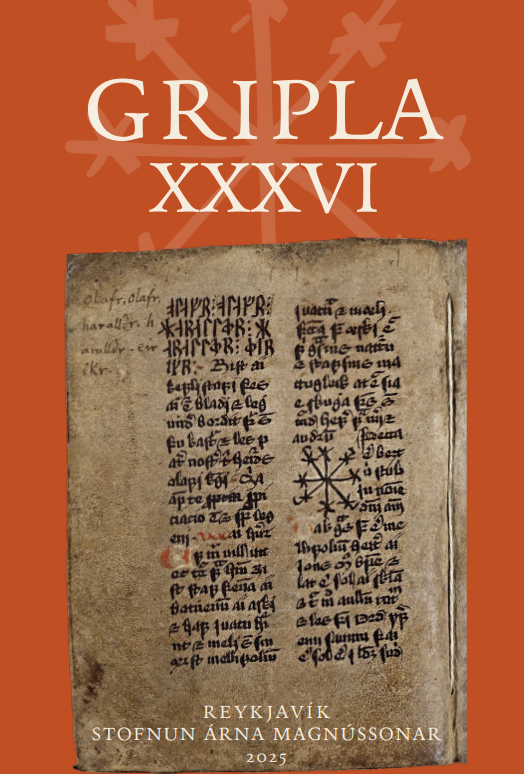
thought to be two of the largest compilations of Íslendingasögur from the medieval period. Since the nineteenth century, scholars have assumed that Vatnshyrna was a codex referred to by Arngrímur Jónsson in his 1609 work Crymogæa and that it could be identified with the manuscript Membrana Reseniana No. 5, also known as Vatnshornsbók. This assumption was implemented by Guðbrandur Vigfússon in 1860 and has profoundly shaped scholarship since, despite being based on speculative and circular reasoning. Although Stefán Karlsson demonstrated that Guðbrandur was mistaken in identifying AM 564a 4to as part of Membr. Res. No. 5, he did not question the assumed connection to Arngrímur’s Crymogæa, which contributed to further confusion in subsequent scholarship.
By examining how Arngrímur Jónsson engages with his sources in both form
and content, I argue that his source Watzhyrna more likely refers to a single
text – possibly a misunderstood or defective manuscript – rather than to a codex
containing at least three distinct sagas. This interpretation challenges the long
standing search for a lost compilation and calls for a shift in approach. I advocate a material-narratological perspective that takes seriously both the textual variants found within the surviving compilations and the nature of the sources Arngrímur himself used. I argue for retiring the name Vatnshyrna in favour of more materially grounded designations. To avoid confusion, the burnt codex Árni Magnússon called Vatnshornbók should be referred to as Membrana Reseniana No. 5, as this shelf-mark is the only certain point we have regarding the content of the manuscript. The fragments previously grouped under the name Pseudo-Vatnshyrna – namely AM 564a 4to, AM 445b 4to, and AM 445c I 4to – should instead be referred to collectively as Melabók. This name, already attached to one of the fragments, more accurately reflects the narrative structure of the manuscript and avoids the confusion that has plagued the name Vatnshyrna. The article also proposes that Melabók should be understood not merely as a container of saga texts but as a carefully constructed compilation with a clear regional and genealogical coherence. The genealogies presented in the opening pages are echoed and elaborated throughout the sagas, suggesting that the selection and redaction of texts was done with a deliberate structural vision. Unlike Vatnshyrna, whose content and composition remain unknowable, Melabók offers a tangible and interpretable body of texts, which can now be examined as a whole. By challenging long-standing assumptions and offering a material-narratological reading of the extant fragments, I hope this study paves the way for more grounded and nuanced understandings of medieval Icelandic manuscript culture and the principles that informed the compilation of saga codices.